Tuesday, June 2, 2009

Summary of presentation at Deakin


This photo shows me at the start of the presentation

A small but enthusiastic group at the Deakin University Warrnambool Library attended an informal presentation of things I had come across on the Fellowship trip. The size of the group made it possible to discuss and compare activities as implemented at Deakin. These included the Deakin Library Facebook Page, the Deakin library catalogue search interfaces that provide images of book covers and links to reviews or summaries, and the library's use of Endnote


This photo shows some of the entranced attendees.

Thursday, May 28, 2009

Presentation at Deakin Uni

A presentation of trip findings -- Deakin Univ. Warrnambool Campus Wed. June 3rd 10.30 am

Monday, February 2, 2009

Presentation at Glenormiston

Findings from the trip were presented at Glenormiston College at the "all staff meeting" on 30th Jan. 2009

Sunday, November 30, 2008

Presentation


On Friday November 28th 2008 the VATL LIT group held its meeting at South West TAFE in Warrnambool. Speakers included Cameron Murrell from Victoria University, Jane Wilson from Swinburne University and Michael Schack from South West TAFE. The photo above shows the presentation on some aspects of the "Wayne Smith Fellowship" trip.

Wednesday, November 19, 2008

Presentation event

The first presentation of the trip will be one of the items at the following event publicised on Facebook

http://www.facebook.com/group.php?gid=20435683973#/event.php?eid=37457991015

Certified participant


This is a scan of the certificate I received after the CILIP workshop on 30th October. I love certificates that are awarded for participation rather than actual competency achievement.

Sunday, November 16, 2008

Back at work at last


The moment I have been looking forward to. back at my desk on November 17th -- my left hand rests on a back log of Age newspapers.

Florence

My attempts to research the Biblioteca Nazionale Centrale in Florence were thwarted when security staff closed the iron gates just prior to my arrival (see photo below). Someone had obviously alerted them.


Trying to decide whether to take the exit or go to the library at the Uffizi Gallery Florence

Rome


This photo shows me on en route to the biblioteca (ie library) at the Vatican. I was not able to gain much access however, nor was a papal audience achieved.

Hamburg


My investigation of the Central Library in Hamburg were inhibited by some language difficulties.
I did however, discover an interesting company (see photo of sign below).

Paris


Unfortunately this library in Paris was closed when I attended (it was a Sunday November 2nd). More information on French libraries can be found at http://lists.webjunction.org/libweb/France.html

Thursday, October 30, 2008

Workshop on Web 2.0 -- London

This was a really great workshop. More later. Organised by CILIP (the Chartered Institute of Library and Information Professionals, the professional body for librarians, information specialists and knowledge managers) this workshop was called Web 2.0: building on the basics. The programme covered: An introduction to the range of Web 2.0 resources available Doing more with blogs – images and audio and more Using storage/filing services and webpage creation tools. What these are, how they can be used and a practical exercise in creating start pages and collaborative websites. Using bookmarking services, web monitoring tools and group search engines, including practical exercise Introduction to wikis and how these can be used to disseminate/alter information within an organisation or group. Social networking services such as Facebook - how do these fit in? Latest developments in the field

Wednesday, October 29, 2008

Oxford

My final library visit was to The Bodleian Library (the main research library of the University of Oxford, and one of nearly 40 libraries within Oxford University Library Services). Web site - http://www.ouls.ox.ac.uk/bodley

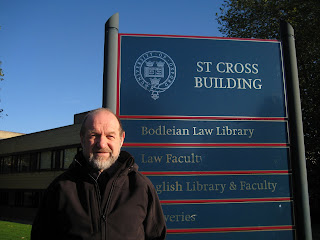
Outisde Oxford University's Bodleian Law Library

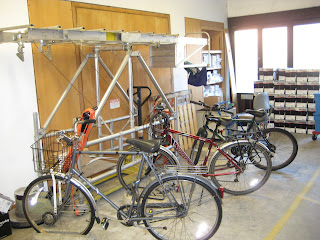
Now this is what our library needs -- bicycle storage at the Law Library


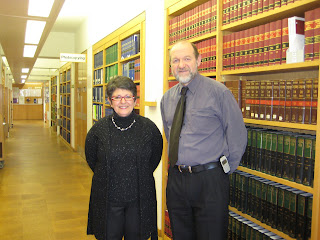
My contact was Ruth Bird (left in the photo) at the Bodleian Law Library (http://www.ouls.ox.ac.uk/law). You can see details of the law library staff at http://www.ouls.ox.ac.uk/law/about_us/staff. Ruth is a close in law of Peter Bird and an ex colleague of Kerry Vickers. She was asking when Peter Bird would be in Oxford.

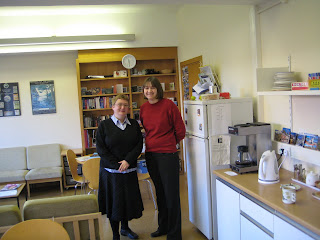
Helen Garner (not not the author) and Angela Carritt in the Law Library staff room (yes they have one -- and any staff member who has been on holidays brings back a treat for all to share. I had some chocolate biscuits that Ruth brought from France).
Angela demonstrated some useful web 2.0 applications, as well as Primo and Metalib. You can see a blog at http://lawbod.wordpress.com and see the use of pageflakes at http://www.pageflakes.com/law.library/24255815

Oxford’s libraries are among the most celebrated in the world, not only for their incomparable collections of books and manuscripts, but also for their buildings, some of which have remained in continuous use since the Middle Ages. Among them the Bodleian, the chief among the University’s libraries, has a special place. First opened to scholars in 1602, it incorporates an earlier library erected by the University in the fifteenth century to house books donated by Humfrey, Duke of Gloucester. Since 1602 it has expanded, slowly at first but with increasing momentum over the last 150 years, to keep pace with the ever-growing accumulation of books and papers, but the core of the old buildings has remained intact
You can read about the history of the library at http://www.ouls.ox.ac.uk/bodley/about/history
The library room was taken over by the Faculty of Medicine in 1556 but it (the library) was rescued by Sir Thomas Bodley (1545–1613), . He married a rich widow whose husband had made a fortune from trading in pilchards and, in his retirement from public life, decided, in his own words, to ‘set up my staff at the library door ..."

The Library offers an online "Ask a librarian" service at http://www.ouls.ox.ac.uk/ask
This involves an online form with fields for name, enquiry etc. Enquiries can also be emailed directly to reader.services@bodley.ox.ac.uk
Some online self paced guides for database use have been developed at http://www.ouls.ox.ac.uk/law/services/training/database_guides. These tutorials provide instructions on the use of specific databases and the user progresses through them by clicking on a continue button. At the end of the instruction the user clicks on close this unit.
Students are welcome to use their laptops in the Library and are advised to buy a lock to secure their laptop whilst here. The Library has both an ethernet and wireless network so that they can access the WWW -- see http://www.ouls.ox.ac.uk/law/services/computing/laptops
The library specifies some minimum service standards for weekends and evenings. See - http://www.ouls.ox.ac.uk/law/services/service_standards
For example staff are expected to answer catalogue enquiries but are only able to offer help with such things as computers and printing at the discretion of the Assistant Librarian in charge on the day. Term Time Opening Hours are Monday - Friday 9am - 10pm, Saturday 10am - 6pm, Sunday 11am - 6pm.
Needless to say the visit was extremely interesting and provided me with many valuable ideas.

Tuesday, October 28, 2008

South Birmingham College


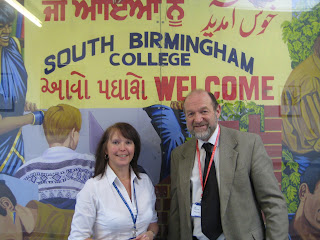
This photo shows South Birmingham College librarian Jan Hillier with myself. Thanks Jan for hosting an interesting visit, the coffee and the map!!


South Birmingham library staff Jan Hillier and Steve Spence.


My latest visit was to South Birmingham College library (website http://gateways.sbc.ac.uk/gateways/index.php?menu=2&submenu=1)


This college library is similar to ours in size and faces similar challenges to us in terms of noise v quiet, computers v social learning, external access to electronic databases, attracting trade apprentices etc. One interesting point I discovered was that disabling a student's computer account had a remarkable affect on the return of overdue books. The client population is much more multicultural than ours and resources for English as a second language are important.


Although now organisationally separated the library and the Virtual Learning Environment (Moodle) seem to have a good level of integration.

Monday, October 27, 2008

Uni of Huddersfield


This photo shows Lynn Barrett (Academic Librarian), Dave Worboys (Academic Librarian), myself, Dave Pattern (Systems Manager), and Graham Stone (Electronic Resources Manager) at the University of Huddersfield.


My 6th visit was to The University of Huddersfield West Yorkshire, England. It has around 20,000 students. The Chancellor is the actor Patrick Stewart, who is originally from Mirfield. See photos of Patrick Stewart opening the refurbished library.

The people here gave us a very hospitable welcome and a great gift pack which included a phrase book for Yorkshire English (very useful) -- thanks for everything.


The library has been extensively refurbished. See photos from 2007 and 2008.
The library provides an "ask a librarian" service (online).
The University of Huddersfield Repository is an electronic archive of the University's research output. See http://eprints.hud.ac.uk/
RSS feeds for this are set up.
The library catalogue is at http://webcat.hud.ac.uk/ipac20/ipac.jsp?profile=cls#focus
This is a Sirsi/Dynix Horizon System. You can subsribe to an RSS feed for a particular search. The most popular keywords are displayed in a "tag cloud". There have been various Web 2.0 add ons to the catalogue.

The Library Systems Manager here is Dave Pattern -- He is well respected in the library world. His blog is at http://www.daveyp.com/blog/ -- See his Library 2.0 ideas.
His "published" works included Are you happy with your OPAC
He was also the bass player in a band "The Headmen"
http://www.daveyp.com/blog/archives/category/the-headmen
Needless to say the visit was extremely interesting and provided me with many valuable ideas.

Friday, October 24, 2008

Finally the weekend


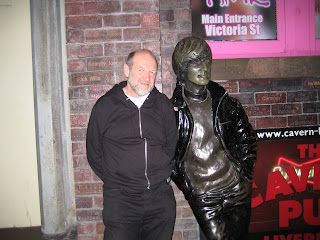
Michael Schack (left) with John Lennon outside the Cavern in Liverpool. John looks a bit darker than I remember.

Facebook symposium


Thanks to the staff at JMU Liverpool I was able to attend a symposium "Facebook -- a network, a research tool, a world". Great presentation by Jane Secker of the LASSIE project (not the dog) --Libraries and social software in education. Tell you more later.


This wasn't on my original schedule but was a great opportunity while in Liverpool (who said I am not seeking out extra work activities?

Visit to University of Liverpool


Photo of Sydney Jones Library http://www.liv.ac.uk/library/
My fifth library visit was to the University of Liverpool. Amazingly this library is open 24 hours a day -- they have check in/check out machines and is staffed only by a warden in the wee hours of the night.


At the University gate


With Systems Librarian Joe Schulkins -- thanks Joe for the very informative demos of web 2.0 applications.


The University of Liverpool was established in 1881 as University College Liverpool, admitting its first students in 1882. In 1884, it became part of the federal Victoria University. Following a Royal Charter and Act of Parliament in 1903, it became an independent university with the right to confer its own degrees called the University of Liverpool. The University has produced eight Nobel Prize winners, from the fields of science, medicine and peace. The Nobel laureates include the physician Sir Ronald Ross, physicist Professor Charles Barkla, the physiologist Sir Charles Sherrington, physicist Sir James Chadwick, chemist Sir Robert Robinson, physiologist Professor Har Gobind Khorana, physiologist Professor Rodney Porter, and physicist Professor Joseph Rotblat. Sir Ronald Ross was also the first British Nobel laureate in 1902. The term red brick was first coined by a Liverpool professor to describe the red brick built civic universities that were built in the UK, mostly in the latter part of the 19th century; these were characterised by Victorian buildings of red brick, such as Victoria Building, which was historically the administrative heart of the University.


The Cafe at the library entrance -- this operates as a franchise


The library has made available a number of search applications that can be placed on an individuals facebook or igoogle or similiar page. See http://liv.ac.uk/library/web_apps.html . A useful web site called Widgetbox was pointed out to me. I was also shown "Question point" -- an OCLC product.

Library users can also use mobile phones and other hand held devices to search the library -- see http://www.liv.ac.uk/library/airpac.html . This is done through a product called AIRPAC. There have been some functionality issues. It was suggested that mini browsers suitable for phones may alleviate some problems with accessing library web pages etc.


The library sells pens, Cds etc at its information desk - see http://www.liv.ac.uk/library/info/libinf15.html


The library has a news page at http://www.liv.ac.uk/library/news/libnews.html They also produce RSS feeds for subject or location related reports from their catalogue. This is done through an Innovative interfaces product.


The process of check RFID tagged items on the shelf was described.


Needless to say the visit was extremely interesting and provided me with many valuable ideas.

Thursday, October 23, 2008

Visit to John Moores University Liverpool


Photo of the Avril Robarts LRC at John Moores University Liverpool (Library web site: http://www.ljmu.ac.uk/lea/)

Photo of the social learning zone at the Avril Robarts LRC -- a place where students can socialise and work in groups on academic pursuits. This photo was supplied by the university. It was full of students while I was there -- very popular.


This photo shows Sarah Pumfrey (Systems librarian), myself and Sue Hodges (Technical Services Manager) at the Technical Services Unit of JMU.


Many thanks for the warm welcome and informative presentations by Stephe, Pam, Sheila, Sarah and Sue (and for the lunch at the British Conservation Centre)


Liverpool John Moores University is a modern university in Liverpool, England. It is named after John Moores and was previously called Liverpool Mechanics' School of Arts and later Liverpool Polytechnic before gaining university status in 1992. On 14 April 2007, Dr Brian May CBE was inducted into the university as the fourth Chancellor of Liverpool John Moores University. He replaced outgoing Chancellor Cherie Booth QC, wife of former British Prime Minister Tony Blair. Honorary fellows in attendance at the ceremony included Sir Patrick Moore and Pete Postlethwaite. There are currently three Learning Resource Centres (LRCs) based at the three campus sites operated by LJMU. The two largest and more modern LRC facilities are the Avril Robarts LRC which is based on the City campus and used mainly (but not exclusively) by students studying on the city campus and The Aldham Robarts LRC (which is based on the Mount Pleasant campus). There are more than 68,500 books in the LRCs' collections, with 1,630 work spaces available for students. In addition to this there are over 16,000 e-books and 5,000 e-journals available. Each LRC operates a booking system to ensure that patrons can always get a slot on a PC. Other PCs are available on a first come first served basis. There is Wireless Network Access at each site to allow the use of personal laptops.


The library uses an Rss feed http://www.ljmu.ac.uk/lea/LEA_Docs/LISNewsFeed.xml for the latest news.


Opening hours are available via a calendar - http://www.ljmu.ac.uk/lea/83095.htm


The library system is Aleph (provided by Ex Libris)


The Library service is integrated with the Blackboard virtual learning environment. There is a learning support section, with links to the library catalogue, and a link to the library services news.


Needless to say the visit was extremely interesting and provided me with many valuable ideas.

Dublin student demo

Before leaving Dublin I honed my demonstration skills by joining in a student demonstration against the introduction of tuition fees. "No way we won't pay" was the chant. I initially thought it was an aged persons' demo against the withdrawal of health care cards for the over 70s, but they're all good causes.