Friday, October 24, 2008

Finally the weekend


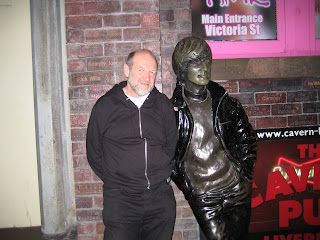
Michael Schack (left) with John Lennon outside the Cavern in Liverpool. John looks a bit darker than I remember.

Facebook symposium


Thanks to the staff at JMU Liverpool I was able to attend a symposium "Facebook -- a network, a research tool, a world". Great presentation by Jane Secker of the LASSIE project (not the dog) --Libraries and social software in education. Tell you more later.


This wasn't on my original schedule but was a great opportunity while in Liverpool (who said I am not seeking out extra work activities?

Visit to University of Liverpool


Photo of Sydney Jones Library http://www.liv.ac.uk/library/
My fifth library visit was to the University of Liverpool. Amazingly this library is open 24 hours a day -- they have check in/check out machines and is staffed only by a warden in the wee hours of the night.


At the University gate


With Systems Librarian Joe Schulkins -- thanks Joe for the very informative demos of web 2.0 applications.


The University of Liverpool was established in 1881 as University College Liverpool, admitting its first students in 1882. In 1884, it became part of the federal Victoria University. Following a Royal Charter and Act of Parliament in 1903, it became an independent university with the right to confer its own degrees called the University of Liverpool. The University has produced eight Nobel Prize winners, from the fields of science, medicine and peace. The Nobel laureates include the physician Sir Ronald Ross, physicist Professor Charles Barkla, the physiologist Sir Charles Sherrington, physicist Sir James Chadwick, chemist Sir Robert Robinson, physiologist Professor Har Gobind Khorana, physiologist Professor Rodney Porter, and physicist Professor Joseph Rotblat. Sir Ronald Ross was also the first British Nobel laureate in 1902. The term red brick was first coined by a Liverpool professor to describe the red brick built civic universities that were built in the UK, mostly in the latter part of the 19th century; these were characterised by Victorian buildings of red brick, such as Victoria Building, which was historically the administrative heart of the University.


The Cafe at the library entrance -- this operates as a franchise


The library has made available a number of search applications that can be placed on an individuals facebook or igoogle or similiar page. See http://liv.ac.uk/library/web_apps.html . A useful web site called Widgetbox was pointed out to me. I was also shown "Question point" -- an OCLC product.

Library users can also use mobile phones and other hand held devices to search the library -- see http://www.liv.ac.uk/library/airpac.html . This is done through a product called AIRPAC. There have been some functionality issues. It was suggested that mini browsers suitable for phones may alleviate some problems with accessing library web pages etc.


The library sells pens, Cds etc at its information desk - see http://www.liv.ac.uk/library/info/libinf15.html


The library has a news page at http://www.liv.ac.uk/library/news/libnews.html They also produce RSS feeds for subject or location related reports from their catalogue. This is done through an Innovative interfaces product.


The process of check RFID tagged items on the shelf was described.


Needless to say the visit was extremely interesting and provided me with many valuable ideas.

Thursday, October 23, 2008

Visit to John Moores University Liverpool


Photo of the Avril Robarts LRC at John Moores University Liverpool (Library web site: http://www.ljmu.ac.uk/lea/)

Photo of the social learning zone at the Avril Robarts LRC -- a place where students can socialise and work in groups on academic pursuits. This photo was supplied by the university. It was full of students while I was there -- very popular.


This photo shows Sarah Pumfrey (Systems librarian), myself and Sue Hodges (Technical Services Manager) at the Technical Services Unit of JMU.


Many thanks for the warm welcome and informative presentations by Stephe, Pam, Sheila, Sarah and Sue (and for the lunch at the British Conservation Centre)


Liverpool John Moores University is a modern university in Liverpool, England. It is named after John Moores and was previously called Liverpool Mechanics' School of Arts and later Liverpool Polytechnic before gaining university status in 1992. On 14 April 2007, Dr Brian May CBE was inducted into the university as the fourth Chancellor of Liverpool John Moores University. He replaced outgoing Chancellor Cherie Booth QC, wife of former British Prime Minister Tony Blair. Honorary fellows in attendance at the ceremony included Sir Patrick Moore and Pete Postlethwaite. There are currently three Learning Resource Centres (LRCs) based at the three campus sites operated by LJMU. The two largest and more modern LRC facilities are the Avril Robarts LRC which is based on the City campus and used mainly (but not exclusively) by students studying on the city campus and The Aldham Robarts LRC (which is based on the Mount Pleasant campus). There are more than 68,500 books in the LRCs' collections, with 1,630 work spaces available for students. In addition to this there are over 16,000 e-books and 5,000 e-journals available. Each LRC operates a booking system to ensure that patrons can always get a slot on a PC. Other PCs are available on a first come first served basis. There is Wireless Network Access at each site to allow the use of personal laptops.


The library uses an Rss feed http://www.ljmu.ac.uk/lea/LEA_Docs/LISNewsFeed.xml for the latest news.


Opening hours are available via a calendar - http://www.ljmu.ac.uk/lea/83095.htm


The library system is Aleph (provided by Ex Libris)


The Library service is integrated with the Blackboard virtual learning environment. There is a learning support section, with links to the library catalogue, and a link to the library services news.


Needless to say the visit was extremely interesting and provided me with many valuable ideas.
Dublin student demo

Before leaving Dublin I honed my demonstration skills by joining in a student demonstration against the introduction of tuition fees. "No way we won't pay" was the chant. I initially thought it was an aged persons' demo against the withdrawal of health care cards for the over 70s, but they're all good causes.

Wednesday, October 22, 2008

DIT

My third library visit was to Dublin Insitute of Technology. The website for the Dublin Institute of Technology library is http://www.dit.ie/library/. Great visit and thanks to all -- too bad I had to leave to get to the airport!

With Senior Librarian (Systems) -- Ursula Gavin


With serials/acquisitions librarian -- Margaret Field (okay -- my eyes are shut, but I am awake!!)


The Sentry entry system to the Library -- very interesting in its ability to get stats on who is coming in -- more later


With librarian Israel Chidavaenzi and Faculty Librarian Anne Ambrose.


The Dublin Institute runs courses from apprenticeships to graduate and post-graduate degrees.
There are seven libraries within the Institute. During term most of the libraries are open from 0930 to 2130 Mondays to Thursdays, 0930 to 1730 on Fridays and from 1000 to 1700 on Saturdays. DIT Library currently stocks more than 250,000 books and other items and subscribes to nearly 20,000 journal titles. The entire holdings of the DIT libraries, their locations and current status are displayed on the Library WebOPAC. This can be accessed in each library and via the Internet at http://library.dit.ie/. The DIT libraries provide study spaces, networked PCs, textbooks and other course materials, reference works and journals to support the programmes offered by DIT and to facilitate research. Information is available in many formats besides books e.g. videos, CD-ROMs, maps and music. Many electronic resources can be accessed from any networked PC. Photocopiers and printers are also available. Some areas of interest at the library are: Blogs -- The Library service home page has a library news column that uses blogs. Virtual reference desk -- You can e-mail your reference enquiries to any DIT library
Wireless services -- Wireless access to Library Services is now available at most DIT libraries This allows staff and students to connect their laptop or PDA to the DIT network without the need for cables. The only requirement is a standard wireless network card in your computer. Google custom search has been applied to the DIT website.
The Library has purchased an institutional license for EndNote (a bibliographic software package that allows you to record and organise personal files of searchable references to books, journals articles,) so that the program is available on every DIT computer. This license also permits staff and students to buy personal copies for laptops or home PCs at a reduced rate. The current cost is €113.97 without a manual or €128.68 with a manual.
Electronic journals have access controlled by the INNOPAC ILMS
Reading lists from the library opac
Book jackets are displayed in catalogue
Needless to say the visit was extremely interesting and provided me with many valuable ideas.

Tuesday, October 21, 2008

Dublin City Library

Although not on my original schedule, I met Eddie Byrne from Dublin City Libraries at the Conference and made a brief visit there. He seems a leader in the field of Web 2.0 applications and he showed me too much in an hour for me to take in in detail. He has generously offered to converse with me on future projects we may try
.
This is me photographed in the conference/events room in the Dublin City Library. Events are often recorded and converted into podcasts, streaming media etc.